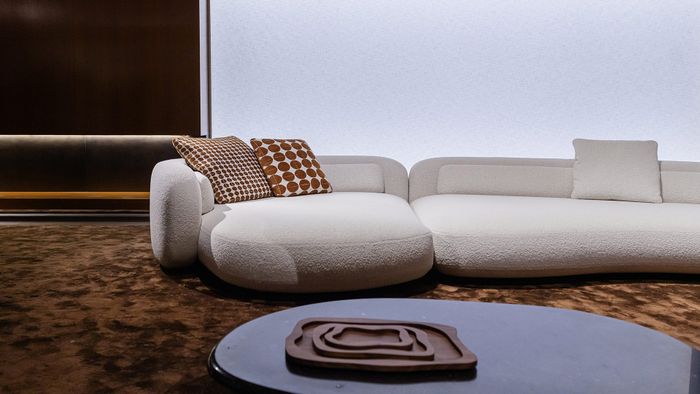
ABITO at Salone del Mobile 2026: When Fashion and Furniture Tell the Same Story
ABITO is the Salone del Mobile 2026 exhibition that uses clothes and furniture as parallel historical evidence - showing how the role of women changed, and how clothing and domestic space reorganised around that change across more than a century. Curated by Palomba Serafini Associati (Ludovica Serafini and Roberto Palomba), promoted by the Italian Ministry of Foreign Affairs, and drawn from the Collezione Quinto Tinarelli fashion archive.
What ABITO Is and Why It Matters
The core idea
ABITO holds its thesis in one word. In Italian, abito means both "a dress" and "I inhabit" - clothing and the act of living. The exhibition treats those two meanings as inseparable: if society changes, the body changes; and when the body changes, the domestic landscape reorganises around it.
The official framing is direct: ABITO "puts fashion and design in relation" to show how society transforms "and with it, the way of living and inhabiting." The storyline is the evolution of women role across the 20th century to today - made visible through changing dress, and understood as a deeper transformation: the conquest of movement, of public space, and of a new posture in the world.
What you will see
The exhibition pairs garments from the Collezione Quinto Tinarelli - a fashion archive spanning over a century - with Made in Italy design objects that are still in production. The deliberate choice of living products argues for the endurance of certain design typologies, materials, and ergonomic ideas across decades. Fashion shows the moment; design shows the continuity.
A sequence of photographic images provides a visual backdrop that makes the passage between historical periods tangible. The curators use photography not only as illustration but as part of the narrative scaffolding itself.
Where it sits in the fair and beyond
ABITO is located at the Stella Polare Congress Centre (South Entrance), Fiera Milano Rho, during Salone del Mobile 2026, which runs 21-26 April 2026 (visitor hours 09:30-18:30). It is promoted by the Italian Ministry of Foreign Affairs and International Cooperation and is described as the beginning of a journey intended to travel through Italy diplomatic and cultural network - embassies, consulates, and Italian cultural institutes - after Milan.
The Five Key Pairings: What to Look For
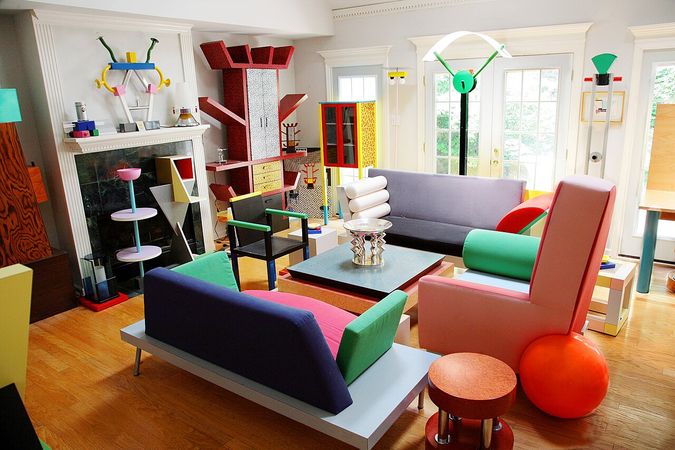
ABITO is structured as a periodised journey developed by historical periods. Each pairing asks you to compare a garment with a design object and answer: What changed in the body? What changed in the home? What changed in public life?
Circa 1905 dress + Chester armchair (Poltrona Frau, Renzo Frau, 1912)
The exhibition opens with an anonymous dress dated circa 1905 paired with the Chester armchair by Poltrona Frau. Chester was introduced in the brand first catalogue in 1912, with leather capitonne and pleated arms hand-executed - a reinterpretation of the English club model.
How to read it: Both objects stage silhouette as social contract. Early 20th-century formalwear signals controlled movement; Chester signals controlled sitting - comfort coded as authority, a body hosted by upholstery that announces permanence. What to look for: the radius of the armrests versus the garment allowed elbow space; the implied duration of sitting; how both objects assume a particular kind of interior - private, upholstered, status-laden.
1967 dress (Laura Aponte) + Up chair (Gaetano Pesce, B&B Italia, 1969)
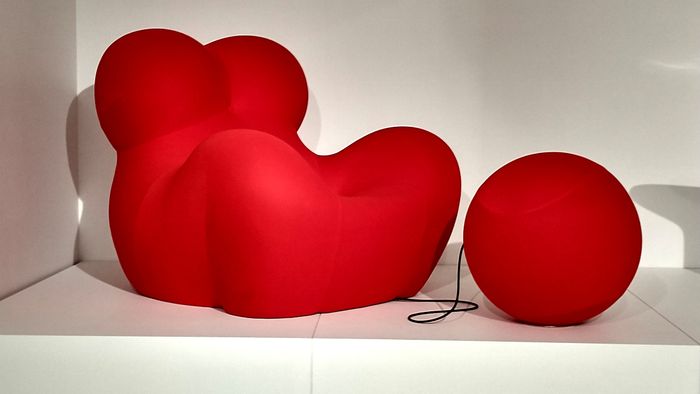
A 1967 dress credited to Laura Aponte is paired with Gaetano Pesce Up chair for B&B Italia (1969). This is the pairing where freedom and labour become almost impossible to separate. The Up chair female-coded form was conceived as a commentary on women oppression, with an ottoman imagined as a ball-and-chain.
How to read it: It turns domestic comfort into a critique of the domestic role. The dress-and-chair dialogue becomes a question: who is "allowed" softness, and at what social cost? What to look for: how the chair holds the pelvis and shoulders compared to the garment line; whether the pairing reads as liberation, capture, or both.
Giorgio Armani FW 1980 + Carlton room divider (Memphis/Ettore Sottsass, 1981)
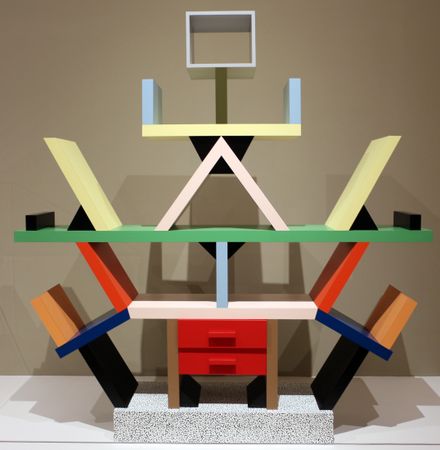
An Armani FW 1980 look is placed beside Carlton (1981) by Memphis and Ettore Sottsass. Carlton combines divider, bookcase, and drawers - high craft meets deliberate laminate as cultural subversion. Armani in the early 1980s is frequently read through composure and public authority; Memphis performs refusal of quiet modernist taste.
How to read it: It visualises a shift from "new posture" as bodily alignment to "new posture" as cultural attitude. What to look for: shoulders and verticals. Armani silhouette logic (structure, line, composure) versus Carlton totemic stacking. Does the home mirror the public sphere or destabilise it?
Gucci SS 1997 + Ferro table (Porro, Piero Lissoni, 1994)
A Gucci SS 1997 piece is paired with the Ferro table by Piero Lissoni for Porro (1994). A useful late-20th-century hinge: the fashion system luxury codes alongside a design object defined by curved metal geometry and a streamlined, surface-disciplined aesthetic.
How to read it: The shift toward leaner lines and a different kind of luxury - less ornament, more discipline. Gesture streamlining visible in both clothing and domestic objects.
Max Mara look + Talenti Grace (Palomba Serafini, contemporary)
The contemporary pairing shows a Max Mara look alongside a Talenti Grace piece by Palomba Serafini themselves. How to read it: the present as editing - contemporary fashion brands and outdoor/contract typologies that treat lifestyle as modular, mobile, and image-forward.
The Two Arguments Running Through ABITO
Permanence versus the ephemeral
ABITO explicit argumentative spine is the contrast between design objects "still in production" and clothing that follows fashion seasonality. The curators treat the archived dresses as time-bound testimony - precious precisely because clothing, unlike design, does not persist in production. The show frames its method as a way "not to lose collective memory" of objects that remain expressions of Italian culture and creativity.
In 2026, this contrast does two strategic things. It gives design culture a way to talk about fashion without defaulting to trend-reporting - ABITO asks what a hemline does to a life, not what the next hemline is. And it quietly reframes "Made in Italy" as continuity of labour and skill, not just a brand label.
Clothing as a technology of permission
A dress is not only a silhouette - it is a range of motion and a map of labour. Waistlines, hems, sleeves, closures: they decide whether you can climb stairs quickly, sit for long periods, cycle, carry a child, work a counter job, commute, or simply be outdoors. ABITO connects that bodily reality to furniture typologies that have their own politics of use: the armchair that assumes leisure, the sculptural seat that reframes the body, the table that presumes new patterns of sociality.
This is where ABITO earns the right to be read as design history rather than fashion-as-decor. The official text notes that in parallel with changes in women clothing, "objects and domestic environments transform too," adapting to "new gestures, new freedoms, new forms of life." Gesture is the bridge between the runway and the living room.
How to See ABITO in Twenty Minutes
The fast route through the argument
- Read the curatorial premise first. Find the wall text about "abito" as clothing and inhabiting, and the stated focus on women movement and posture. This is the key that makes the pairings legible as history rather than styling.
- Focus on three pairings across eras - the circa 1905 pair, the 1969 pair, and the 1981 pair. Each answers one question: What changed in the body? What changed in the home? What changed in public life?
- Scan the photographic backdrop. The Salone text describes a visual sequence that makes transitions between periods tangible. If you miss this, you miss the exhibition pacing.
How to photograph it
ABITO is photographic by design - many official images are credited to Palomba and the exhibition uses photography as part of its narrative scaffolding. The most useful approach is documentary:
- Photograph the pairing as a sentence, not as two separate nice objects: include garment and furniture in one frame when possible, so the viewer can read posture and scale together.
- Capture labels and wall text where permitted; the exhibition research logic depends on making attribution verifiable.
- Salone FAQs state that personal photography is generally permitted. Professional or commercial use typically requires press accreditation. Verify exhibitor-specific policies on site.
Practical information
- Location: Stella Polare Congress Centre, South Entrance, Fiera Milano Rho
- Dates: 21-26 April 2026
- Hours: 09:30-18:30 (aligned to fair hours)
- Access: Trade 21-26 Apr - Students 24-26 Apr - General public 25-26 Apr
- Getting there: Metro M1 (red line) to Rho-Fiera, last stop. South entrance leads directly to Stella Polare Congress Centre.
Why ABITO Stands Out in Milan Design Week Coverage
When Milan Design Week becomes a blur of product launches, ABITO offers a rare editorial clarity: it proposes that the most interesting design story is not "what is new" but "what changed in how we live." That emphasis is operationalised through pairings that make social history physically comparable - objects you can stand next to, not just read about.
The announced travel of the exhibition through Italy diplomatic and cultural network further distinguishes it from a one-week spectacle. ABITO is designed to circulate ideas internationally - about Italian design, women history, and the relationship between the body and domestic space - long after the Salone flags come down.