Aurea, an Architectural Fiction: Complete Guide to Salone del Mobile 2026's Immersive Hotel Installation
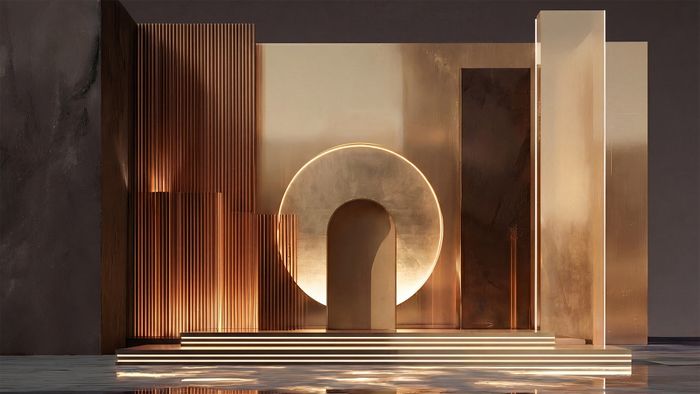
Aurea, an Architectural Fiction is the centrepiece immersive installation of A Luxury Way at Salone del Mobile 2026. Conceived by Maison Numero 20 and founder Oscar Lucien Ono, it is positioned in Pavilions 13-15 at Fiera Milano Rho and runs 21-26 April 2026. Not a stand to browse - an imaginary hotel to enter.
At a Glance
| Detail | Confirmed information |
|---|---|
| Dates | 21-26 April 2026 |
| Location | A Luxury Way, Pavilions 13-15, Fiera Milano Rho |
| Opening hours | Visitors 09:30-18:30 - Press from 08:30 |
| Access by category | Trade 21-26 Apr - Students 24-26 Apr - Public 25-26 Apr |
| Studio | Maison Numero 20, Paris - founded by Oscar Lucien Ono |
| Ticket (trade presale) | 60 EUR until 17 Apr 23:59 CEST |
The Setting: Where Aurea Fits Inside Salone 2026
A Luxury Way and why Aurea is its centrepiece
A Luxury Way is Salone del Mobile 2026 dedicated lane for timeless objects and high-end living, housed in Pavilions 13-15. Aurea is its headline installation - an "imaginary hotel" that turns interior design into narration and scenography, leveraging emotional and sensory dimensions of living.
The 64th edition runs Tuesday 21 to Sunday 26 April 2026. Salone frames 2026 as an "integrated architecture of content and exhibition itineraries" and explicitly positions the fair as both commercial platform and "evolving cultural infrastructure." Aurea is designed to be experienced as environment, not catalogue.
What is confirmed vs what remains unspecified
Confirmed (from official sources): the installation author (Maison Numero 20), placement (A Luxury Way, Pavilions 13-15), conceptual structure (room-by-room sequence, luxury as evocation, sustainability/circularity framing), and at least one named material partner (Nagami Design, which transforms ocean-recovered plastic into new-generation furnishings).
Unspecified as of 10 April 2026: exact floorplan footprint, entry/exit points within the pavilion, queue or timed-slot policy, full credits list for textiles/lighting/sound, and photography permissions. Verify on-site via the credit panel and the official press sheet.
The Method Behind the Spectacle
Architectural fiction as a design tool
Officially, Aurea is described as "a reflection on design as a narrative form" - a mise-en-scene of the imaginary, where interior decor becomes story and scenography. The framing is useful because it tells you how to judge what you are seeing. Instead of asking "Do I like this room?", assess whether the installation delivers three things that narrative environments must deliver:
- Legible sequence: you should feel a beginning, middle and end.
- Controlled transitions: corridors and thresholds are treated as part of the story, not dead space.
- Meaningful detail density: objects and surfaces should accumulate into a coherent world, not an uncontrolled moodboard.
Who is behind it
Maison Numero 20 is a Paris-based interior design studio with a team of over twenty and more than thirty hotels designed - which explains why the installation leans hard into hotel dramaturgy rather than domestic realism. Oscar Lucien Ono frames the project as a "personal vision of hospitality" shaped through narrative composition and a "sensitive dialogue between light and matter."
The wider Milan immersive shift
In recent years, design weeks have increasingly used cinematic or performative staging to deliver experiences that resist reduction to product images. Aurea is Salone official, fairground-sited version of that logic: an installation meant to create a memorisable "you had to be there" set of spatial impressions while still speaking to specifiers and decision-makers.
The Imaginary Hotel in Five Scenes
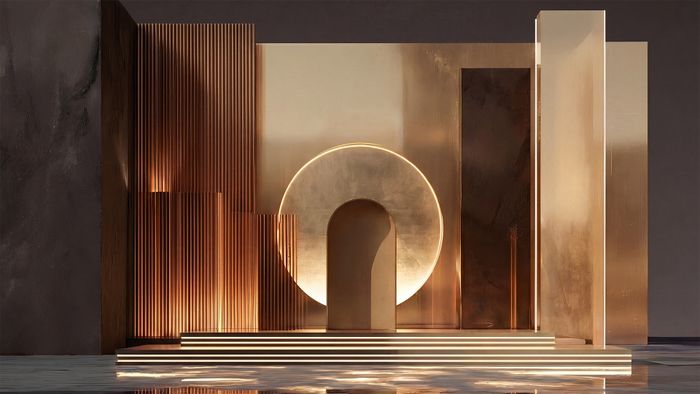
The installation is structured as a series of five theatrical spaces inviting visitors to see themselves as travellers. These room names are the closest thing to an official map you can use before arriving. Treat each scene as a function and document the design devices that produce it.
Hall of Dreams
The beginning of the exploration: arches and subdued lighting that act as a threshold into a dreamlike world. What to look for: compression, darkness-to-light pacing, and the first "value signal" - is luxury conveyed by material mass, or by restraint and control?
Velvet Salon
An enveloping space with a stylised fireplace, framed as a meditation space with a sense of suspended time. What to look for: acoustic damping (soft surfaces), how seating is positioned (conversation vs introspection), and how "comfort" is staged without domestic cliches.
Forbidden Oasis
A veiled, sensual Art Deco drawing room with lacquered palm trees and a "secret atmosphere." What to look for: partial concealment, filtered sightlines, and the deliberate use of reference (Art Deco) as emotional shorthand. Photography tip: capture the veil - what you cannot quite see - rather than only the objects.
Thousand Nights Suite
An "Oriental fairytale" private palazzo with mother-of-pearl mosaics and silken drapes. This is where the installation risks sliding into pure fantasy. For rigorous reading, document labour and craft evidence: joinery, mosaic technique, textile edges, and how light interacts with reflective fragments - which is often the real luxury device.
Midnight Bar
A clandestine finale where nocturnal charm and golden light create "ghostly elegance." What to look for: social choreography - standing vs sitting, how circulation encourages gathering, and how "bar" atmospherics are built through light temperature, reflection, and visual depth.
Documentation Grid for Your Visit
Use this as an evidence-capture method, especially if you are writing a report for a client or building a post-show internal deck:
| What to capture | Why it matters | Best format |
|---|---|---|
| Threshold moment in each room | Proves the narrative sequence exists | 1 wide photo + one sentence |
| A single hero surface per room | Surfaces carry much of the luxury argument | 1 close-up + lighting note |
| Credit/partner panel (if present) | Moves claims from vibe to verifiable | Straight-on photo |
| One transition (corridor/turn) | Transitions are the core staging tool | 10-15 sec video or 2-frame series |
| Your emotional response, timestamped | Useful for post-show recall and comparison | Notes app, 1-2 lines |
Luxury as Evocation and Responsibility
How luxury is being defined here
Across official materials, the rhetorical pivot is explicit: luxury is "not ostentation, but evocation." The installation is framed as a dialogue between excess and subtraction, matter and vision, and a "timeless language" blending heritage, innovation and emotion.
The name "Aurea" references the Latin aureus ("golden," "brilliant," "precious") and the golden ratio, positioned as a symbol of harmony and visual completeness. Use it as an interpretive lens: look for proportional calm and measured pacing rather than maximal display.
The sustainability claim - and how to verify it
Officially, Aurea is framed as "a manifesto of sustainability": every element from materials and fabrics to lights and installations was chosen with circularity and environmental respect criteria. A named partner example is Nagami Design, which transforms plastic recovered from the ocean into new-generation furnishings.
The full bill of materials and supplier list remains unspecified in public documents. Because "sustainable luxury" can easily become vague, here is an evidence-based verification method for your visit:
- Photograph the credits wall (if present) and request the official supplier list.
- Ask what is reused or recyclable vs what is single-use construction, especially scenic cladding.
- If a material is described as recovered or recycled, ask for brief provenance: origin, processing, certification.
Connection to the contract conversation in 2026
Even though Aurea is theatrical, it is strategically aligned with Salone contract-facing evolution. Official materials emphasise integrated itineraries and the runway toward the 2027 Salone Contract platform under a masterplan by OMA. For A&D professionals, this frames Aurea as more than an art moment: it is a live prototype for how hospitality value is commissioned - atmosphere, sequence, and sensory cohesion as measurable project assets.
Practical Visitor Guide
Best times and crowd strategy
If Aurea is a priority, schedule it first - early cognitive bandwidth - and treat it like a museum visit: slow, deliberate, evidence-capture. The crowd profile differs sharply by access category; the most reliable planning anchor is press access from 08:30 and trade from 09:30.
Recommended timed walkthrough
- 08:45 - Arrive at fair with security buffer (press) or 09:15 (trade)
- 09:30-09:40 - Walk to Pavilions 13-15
- 09:40-09:48 - Hall of Dreams (8 min)
- 09:48-09:58 - Velvet Salon (10 min)
- 09:58-10:08 - Forbidden Oasis (10 min)
- 10:08-10:20 - Thousand Nights Suite (12 min)
- 10:20-10:30 - Midnight Bar (10 min)
- 10:30-10:40 - Exit and debrief notes
- 10:40 - Continue to next priority hall or meeting
How to get there
Take Metro line M1 (red line) to Rho-Fiera station (last stop), which connects directly to the fairground halls via covered walkways. A 3-zone ticket is required. Contactless payment is available on ATM services. Driving is also possible via dedicated trade parking. Use the official Salone interactive map to confirm your entry gate for Pavilions 13-15.
Ticket prices (official, pre-show)
- Trade presale: 60 EUR (until 17 April 23:59 CEST)
- Public weekend presale: 38 EUR
- Student tickets: from 15 EUR online
Tickets are digital and require registration. Verify current pricing via the official Salone admissions page before purchasing.
How to Photograph Aurea Without Flattening It
Aurea is designed to be photogenic. The editorial risk is that you end up with isolated surfaces that do not communicate sequence - and therefore miss the point. Use a three-layer capture rule:
- One wide per room - proof of spatial composition
- One transition - proof of choreography between scenes
- One material detail with light - proof of the "evocation" claim
Avoid blocking thresholds; wait for moments where the room reads as atmosphere, not crowd. Photography permissions are unspecified pre-show - verify signage and ask staff on site.
Mini Glossary
- Architectural fiction: A design method that uses an imagined programme (here, a hotel) to structure spatial narrative and visitor behaviour. Official description frames Aurea as a reflection on design as narrative form.
- Mise-en-scene: The orchestration of space, light and objects as staged experience. Used in official descriptions of Aurea.
- Scenography: Spatial storytelling logic borrowed from theatre and cinema. Official texts explicitly frame interior decor as story and scenography.
- Evocation (in luxury): A definition of luxury positioned as atmospheric and emotional rather than ostentatious. A key official claim you can test through evidence capture during your visit.
- Circularity: Design and material selection aimed at reuse, recycling, and reduced environmental impact. Aurea is officially framed as a sustainability manifesto using circularity criteria.
- Golden ratio: A proportional concept invoked as part of the "Aurea" naming logic. Useful as interpretive lens, not proof of design quality.